Giuseppefortunatolorenzolotto
Cingoli dal 31 Luglio al 22 Agosto 2010
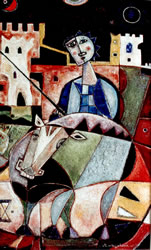
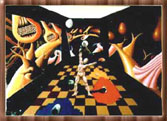
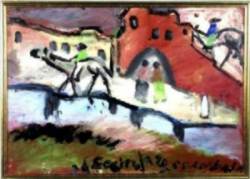
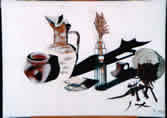
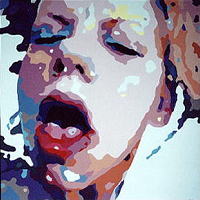
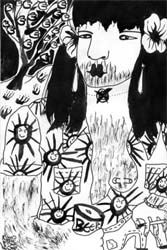
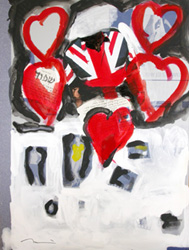
In mostra 24 lavori di Giuseppe Fortunato sulle opere di Lorenzo Lotto
Critical presentation of Armando Ginesi
Edited by Francesco Pieroni
I do not believe in numerology but it happened I also used it to my advantage, about twenty years ago, when I used to travel in China. The Chinese are very careful about what they consider to be signs of destiny (scattered everywhere, even amongst numbers) and I, son of the rationalist West, stemming from Greek thought, was looking with a certain effort, for the truth, and to fold their propensity to my interest at that time. And I succeeded well, as I could tell you plenty about how I brought up Marco Polo, Li-ma-Do (Matteo Ricci), Lang-Shi-Ning (Giuseppe Castiglione). But that's another story.
Nor do I believe in metempsychosis (nor that of Pythagorean, nor Plato nor Hindu nor Buddhist) and yet there is, in the life (and birth) of Giuseppe Fortunato, some curious incidents that lead one belief to the other. So, Fortunato, painter, living in Cingoli in The Marche, where in the church of Saint Domenico is kept one of the best (and with partial arcane meanings, according to the iconologic analysis ) altarpieces, painted by Lorenzo Lotto, in 1539. Fortunato lives in The Marche but was born elsewhere (Abruzzo); Lotto lived, worked and died in The Marche but came from Veneto. The old master died in 1556 and the contemporary artist was born in 1956, exactly 400 years after his death. Does it mean something? From the logical point of view certainly not, perhaps just a curious coincidence. But if we go back to numerology and metempsychosis, mentioned at the beginning, maybe ... ... ... ....
Nobody can reasonably think that Lorenzo Lotto, dying, transmigrated his soul into that of Giuseppe Fortunato (One would ask where it had been and what had it been doing during 400 years of hibernation!):Rational talking? definitely not! But if one thinks that Fortunato is the inventor of Assempaforism (to know more see the artist's bibliography, or even better the text of Charles Occhipinti 1988) then one can believe that the assempaforic view - this makes sense; or non-sense that assempaforicamently speaking, does the same thing. Why is Assempaforism a land of paradox?
We know that, sometimes, in art lurks a strong playfulness. So is the expressiveness of Fortunato for playing and that of irony (the latter subtle sometimes without trace) chase each other, find each other, come together. This is what happens when our Abruzzese- Marchisan artist collides with and deepens the works of this 16th century painter whose mannerisms shows the "flavour to go against the grain" (as says Giulio Carlo Argan) controversially and, sometimes, a bit irreverent ..
What is one soul (the same) to act or have two, it is certain that the answer to the worries of the world seems to be (taking into account those four centuries that have passed) the same: ironic, amused, paradoxical.
We now live in an era that has, in any event creative, expressive preferred modes of quotations. It quotes the thoughts of others (even visual) in support of their own. And while we love contamination: genera, materials, eras, styles. So Fortunato contaminates the works of Lotto. If it is true - always talking assempaforicamently - that the Lotto soul is transmigrated into the Abruzzese-Marchisan painter, it is now in the twenty-first century, almost by enforcing Dante's law of retaliation, to penetrate into visual imagery of the Venetian through the manipulation of images and spaces of some of his famous paintings. The visual alphabet of Fortunato approaches, without violence, rather with respect to form and colour, albeit with a considerable dose of fun, to that of Lotto and seems complete, the modernization makes it a digestible meal for the hermeneutics of our time . Then weaves - albeit ironically - a web that connects past and present, tradition with modernity. This represents a confoundedly serious discourse over a period of history that lost the sense of the past and was no longer capable of thinking, if not awkwardly, to the future, remaining passively in a state of ephemeral, fragile, hedonistic use of here and now without any perspective, is both forwards and backwards. But the irony one can't stress it enough - is something to be taken seriously because it makes you think. Of course those who are able to do so.
Armando Ginesi